
Absolam Rebels
David, Absalom, and the Heart of Repentance
Welcome, parents! This week in our lessons, we explored a heavy and complex chapter in the history of Israel’s monarchy: the rebellion of Prince Absalom against his father, King David. While the scale of the conflict involves kingdoms and armies, the roots of the story are found in the home. Our goal this week is to help you bridge the gap between this ancient narrative and your daily family life, examining how our hearts respond when we fail and how we can lead our children toward true repentance.
A Tale of Two Sins
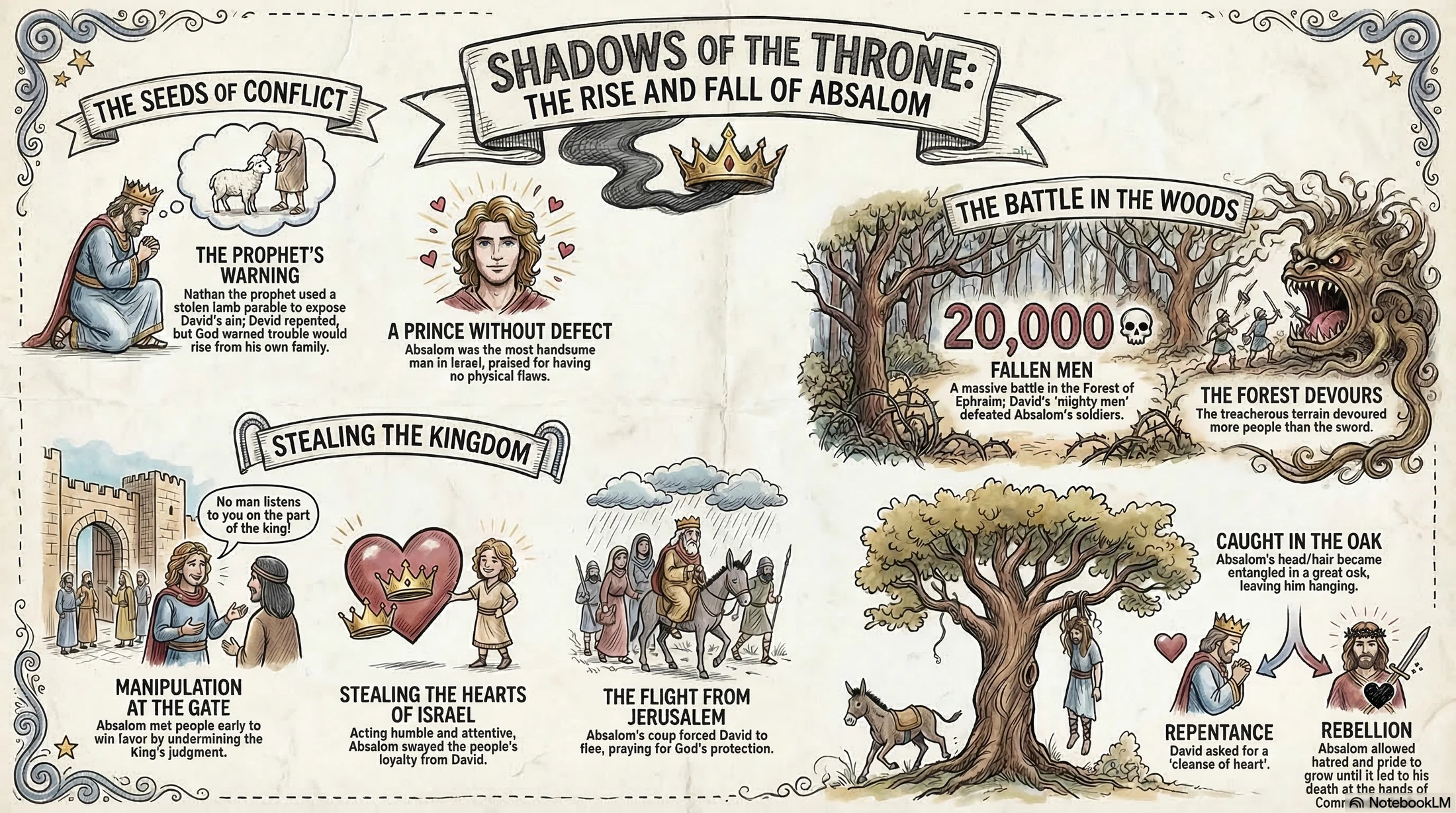
To understand the "trouble" in David's house, we must look back at David’s own failure. Though he was a man after God’s own heart, David committed a series of devastating sins: taking Bathsheba and then arranging for her husband, Uriah, to be killed in battle to cover up his actions. God sent the prophet Nathan to confront the king using a parable about a rich man who stole a poor man’s only beloved pet lamb.
When David reacted in righteous anger, Nathan delivered the stinging rebuke: "You are the man!" David’s response was immediate and sincere; he did not make excuses but confessed, "I have sinned against the Lord." While God in His mercy forgave David’s soul, the earthly consequences were severe. As Nathan prophesied, the sword would never depart from David’s house, and the immediate consequence was the tragic death of David and Bathsheba’s infant son. This week's lesson on Absalom shows the continued
"trouble" God warned would arise from within David's own family.
Absalom: The Prince Who Stole Hearts
Absalom, David’s third son, was a man of striking appearance. According to 2nd Samuel 14:25, he was the most handsome man in all Israel, without a single physical defect from head to toe. He was particularly known for his thick hair, which he cut only once a year because it became too heavy. However, this outward beauty masked a heart hardened by pride and bitterness. After murdering his brother Amnon—mirroring his father’s sin of bloodguilt but without his father’s heart of repentance—Absalom began a calculated four-year campaign to undermine the King.
- Calculated Interest: He rose early and met people at the gate, asking, "From what city are you?" to make them feel seen and heard by the royal family.
- Undermining Justice: He would tell people their claims were "good and right," but then lie and say the King had no one appointed to hear their grievances.
- False Humility: He would openly wish to be appointed judge, promising that he would be the one to finally give everyone true justice.
- Strategic Affection: When people tried to bow to him, he would stop them, take their hand, and kiss them, using physical affection to manufacture a sense of equality and friendship.
The Rebellion and the Forest Battle
The tension eventually exploded into open civil war. David was forced to flee Jerusalem in a state of mourning, weeping as he ascended the Mount of Olives. Even in his distress, David’s posture remained one of reliance on God. He organized a network of spies to remain in the city and gathered his "mighty men"—seasoned, loyal warriors—to prepare for the inevitable clash.
The final battle took place in the forest of Ephraim. The biblical text notes that the slaughter was great, with 20,000 men killed that day. Remarkably, the scripture records that the forest itself "devoured more people that day than the sword devoured." God used His very creation as an instrument of justice to thwart the rebellion.
Absalom’s end was a direct irony of his vanity. While riding a mule under a great oak tree, his head (and likely his famous long hair) became caught in the thick branches. As the mule ran on, the prince was left hanging "between heaven and earth." Despite David’s orders to spare his son, the commander Joab killed Absalom while he was trapped, ending the rebellion and restoring David’s throne.
Repentance vs. Pride
Dinner Table Discussion Guide
- Scriptural Insight: When Nathan confronted David, David didn't try to hide or blame others. He recognized that his sin was ultimately against God. Absalom, however, spent years planning and hiding his sin. True repentance involves a "change of mind" that turns away from the sin and back toward God, whereas a hard heart only looks for ways to get ahead.
like him. How can we tell the difference between being a true friend and being
a manipulator?
- Scriptural Insight: Absalom’s "friendship" was a tool to get the throne; he used people's problems to make his father look bad. A true friend, like the "mighty men" who stayed with David, is loyal even when things are difficult and doesn't use others to gain power or popularity.
Question 3: When everything felt like it was falling apart, who did David
turn to for help?
- Scriptural Insight: David prayed. He knew that even though he was suffering the "troubles" God promised, God was still his only source of protection. He trusted God’s plan more than his own ability to fight.
This story is a sobering reminder that our choices have a lasting impact on our families. However, it also offers a beautiful hope: God is a protector and a restorer to those who approach Him with a humble heart. As parents, one of the most powerful ways we can disciple our children is by modeling repentance. When we fail or lose our tempers, we have the opportunity to show them what David showed Israel—that there is grace for those who stop covering up and start confessing. May your home be a place where pride is set aside and the "heart of repentance" is celebrated.