
From Caves to Crowns
Bringing the Lessons of David and Saul into Your Home
As parents, we often find ourselves caught between wanting to share the
"big" stories of the Bible and wondering how to explain the darker,
more complex moments. How do we explain a king visiting a medium, or a fugitive
hiding in a cave, in a way that makes sense to a seven-year-old or a teenager?
It can feel like a daunting task to move these narratives from the
"ancient history" shelf to the "daily life" shelf.
My goal today is to help your family move from simply hearing the story
to living the lessons. The transition from Saul’s reign to David’s kingship
isn’t just a political drama; it’s a blueprint for building a heart after God’s
own. By looking at these two men, we can teach our children about integrity,
the weight of obedience, and the beauty of trusting God’s timing—even when life
feels like a "cave" season.
The Tale of Two Hearts
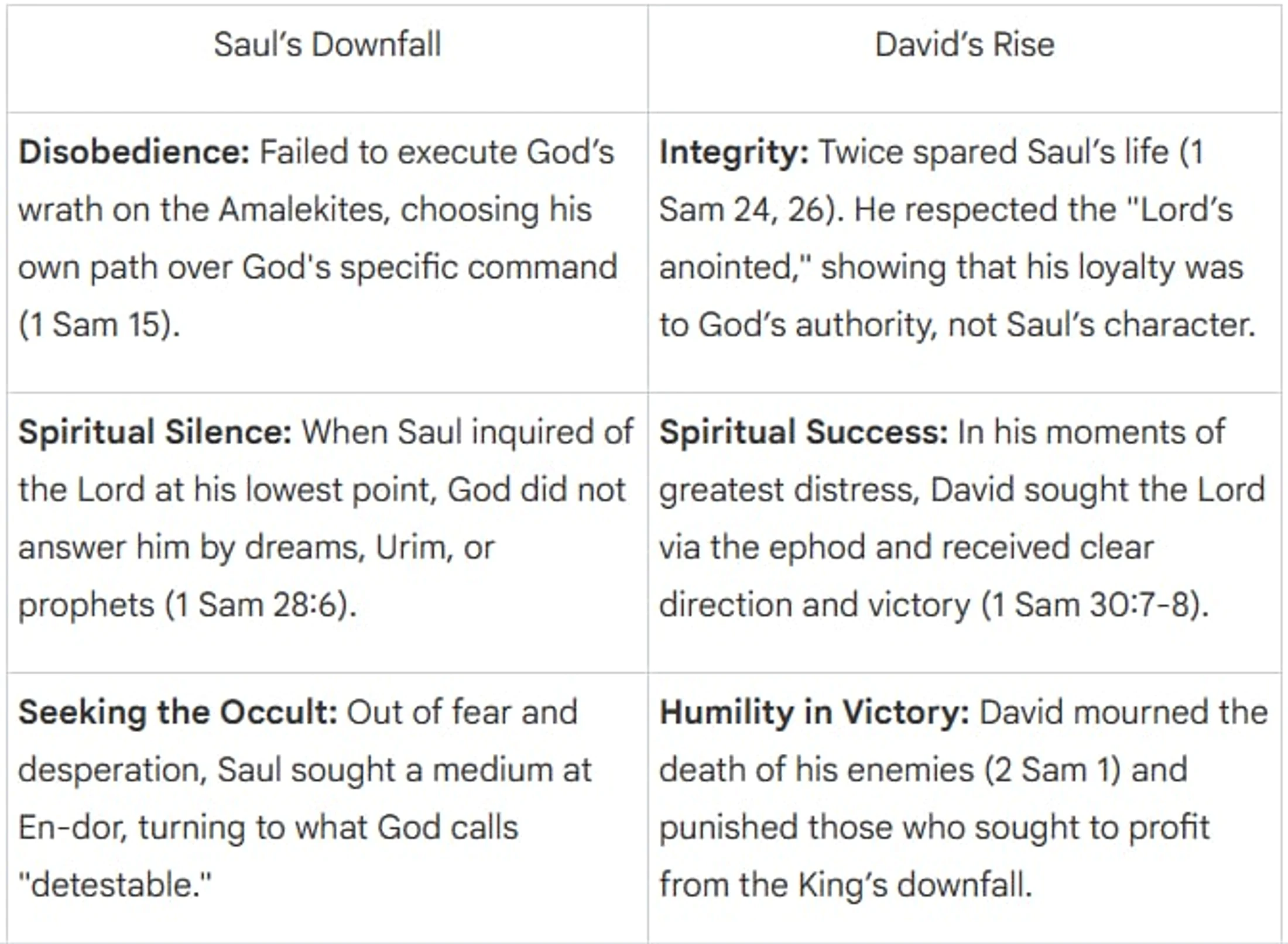
The shift from Saul to David represents a
fundamental change in leadership style: from a man governed by fear to a man
governed by faith. While Saul looked for shortcuts and buckled under pressure,
David learned to wait on the Lord. The table below highlights the stark
contrast in their spiritual trajectories as found in the accounts of 1st Samuel.
Integrity When No One is Watching
In 1st Samuel 24 and 26, David was presented with two perfect opportunities
to end his exile by killing Saul. In the darkness of a cave at Engedi and the
silence of a sleeping camp, David’s men urged him to take the throne by force.
They even framed it as a "gift from God."
But notice the sensitivity of David's heart. In 1 Samuel 24:5, the text
says David’s "conscience bothered him" just for cutting a corner of
Saul's robe. This is a vital lesson for our children: True integrity is a
matter of the heart. David didn't just avoid murder; he was grieved by a
lack of respect. He told his men, "I will not stretch out my hand against
my lord, for he is the LORD’s anointed." David understood that respecting
Saul was actually an act of respecting the God who had placed Saul in power.
Coach’s Tip for Parents: Ask your child: "Have you ever had a chance to 'get even' when
no one would know? Why did David choose to wait for God to give him the crown
instead of taking it himself?" The Lesson: We don't have to
"grab" what God has promised; He is faithful to provide it in His way
and His time.
The Danger of the "Easy Way Out" (Saul and the Occult)
When we feel abandoned or when God seems silent, the temptation is to
find answers on our own terms. Saul’s visit to the medium at En-dor (1 Samuel
28) is a tragic warning of what happens when we refuse to repent. Saul had
previously removed mediums from the land, but when God became his
"adversary" because of his persistent disobedience, Saul turned back
to the very things God calls an abomination.
God:
- Leviticus 19 & 20: Seeking mediums defiles us and
causes God to "set His face" against us. - Deuteronomy 18: Practices like divination,
sorcery, and inquiring of the dead are "detestable" to the Lord.
deliver a final message of judgment. Saul’s refusal to trust God’s silence led
to three devastating consequences:
- Silence from God: Because Saul killed the priests
and lived in unrepentant sin, the heavens became brass to him. - Loss of Kingdom: Samuel confirmed that the
kingdom had been "torn" from Saul and given to David. - The Prophecy of Defeat: Saul was told that he and his
sons would die the very next day—a prophecy fulfilled on Mount Gilboa.
The Power of Wise Intervention (The Story of Abigail)
Character isn't just about our own choices; it’s about how we influence
others. In 1 Samuel 25, we see David nearly succumb to a "mistake of
anger." When a wealthy, harsh man named Nabal (meaning "folly")
insulted David’s men, David prepared for a massacre.
Enter Abigail. She was more than just a peacemaker; she was a woman of prophetic
discernment. She brought a gift of food and spoke words that reminded David
of his destiny. She recognized that the Lord would "make for my lord an
enduring house" (1 Sam 25:28). By reminding David of who he was in God's
eyes, she saved him from the guilt of unnecessary bloodshed.
Be a Wise Intervener: As a family, discuss how you can be like Abigail this week. When a
sibling or friend is getting angry or about to make a bad choice, how can you
use "wise words" to help them stop and think? Activity:
Practice saying, "I know you're better than this choice," or "Let's
take a minute to ask God what to do."
Is the "House of David" Real?
As your children grow, they may encounter skeptics who claim King David
was just a myth or a legendary character like King Arthur. However, archaeology
confirms the Bible's historical accuracy.
In 1993–1994, archaeologists at Tel Dan in northern Israel
discovered a stone fragment known as the Tel Dan Stele. Dated to 950–800
BC, it contains an inscription by Hazael, the King of Aram. Even though
Hazael was a foe of Israel, he bragged on this monument about defeating
the "House of David." This discovery, currently on display in
the Israel Museum in Jerusalem, proves that David was a real king who
established a real royal dynasty.
History and Scripture agree: David's throne was as real as the lessons we
learn from his life.
Discussion & Application Guide
Dinner Table Questions (with Parent's Key)
- Q: Why did David punish the
Amalekite who claimed to kill Saul instead of rewarding him? - Parent Key: David had a high view of God’s
authority. Even though Saul was his enemy, David respected the office of
"the Lord’s anointed." He would not honor someone who claimed
to have raised a hand against the man God had chosen (2 Samuel 1). - Q: How did David "strengthen
himself in the Lord" when his own men wanted to stone him at Ziklag? - Parent Key: According to 1st Samuel 30:6-8,
David didn't panic or argue. He called for Abiathar the priest to bring
the ephod (a priestly garment used to seek God's will). He turned his focus away from his problems and sought specific direction from God. - Q: What does David’s lament over
Saul and Jonathan (2nd Samuel 1) tell us about how we should treat our
enemies? - Parent Key:
David chose to remember the "beauty" and the "mighty"
things about Saul and Jonathan. He didn't use the funeral to bring up old
grudges. This teaches us to leave judgment to God and treat even our enemies
with dignity
Trusting the Shepherd King
David’s journey from the wilderness caves to the Jerusalem crown was not
a path of perfection, but a path of persistence. In 2nd Samuel 5:2, we see his
true calling: David was chosen to "shepherd" God's people.
Parents, encourage your children today that their character is being
built in the "hidden" moments. Choosing God's way when no one is
looking, refusing the "easy way out," and speaking words of peace may
feel like a cave season, but it is actually the preparation for a crown. Let us
lead our families to follow the heart of the true Shepherd.